Brasília’s Hidden Traps: What No One Tells You About Its Theme Zones
You’ve seen the postcards—Brasília’s futuristic skyline, its grand monuments rising from the savanna. But behind the sleek architecture lies a city that can trip up even savvy travelers. I went expecting cultural depth and got sterile plazas and confusing layouts. This isn’t just about wrong turns—it’s about mismatched expectations. Let’s unpack the real Brasília: its themed zones, urban design pitfalls, and how to navigate them without losing your sense of wonder.
The Allure of a Planned Capital
Brasília stands as one of the most ambitious urban experiments of the 20th century. Conceived in the late 1950s and inaugurated in 1960, it was built from scratch to serve as Brazil’s new inland capital, shifting political power away from the coastal cities of Rio de Janeiro and São Paulo. Designed by urban planner Lúcio Costa and architect Oscar Niemeyer, the city was envisioned as a symbol of modernity, progress, and national unity. Its Plano Piloto, or Pilot Plan, resembles an airplane or bird in aerial view, with clearly defined sectors designated for specific functions: government, housing, commerce, and culture. This radical approach to city planning earned Brasília UNESCO World Heritage status in 1987, praised for its modernist architecture and bold urban vision.
At its core, Brasília was meant to be a city of order and harmony. Costa’s design emphasized separation of functions to reduce congestion and improve efficiency. The Monumental Axis houses federal institutions, while the Residential Superblocks provide standardized living spaces intended to foster equality among citizens. Cultural centers, schools, and healthcare facilities were evenly distributed to promote social equity. In theory, this zoning created a balanced, rational city where every resident had access to essential services within their sector. The architects believed that beautiful, functional design could shape a better society—one where aesthetics and social justice coexisted.
Yet, this same structure that promised clarity and efficiency has also contributed to Brasília’s most persistent challenges. The rigid zoning, while logical on paper, often fails to account for the organic rhythms of daily life. Visitors frequently describe the city as feeling sterile or impersonal, lacking the warmth and spontaneity found in older Brazilian cities. The absence of mixed-use neighborhoods—where homes, shops, and cafes blend together—means that Brasília does not invite casual exploration. Instead, it demands intentionality: you must know where you are going and how to get there. For many tourists, this disconnect between expectation and experience becomes apparent within hours of arrival.
The Monumental Core: Beauty vs. Accessibility
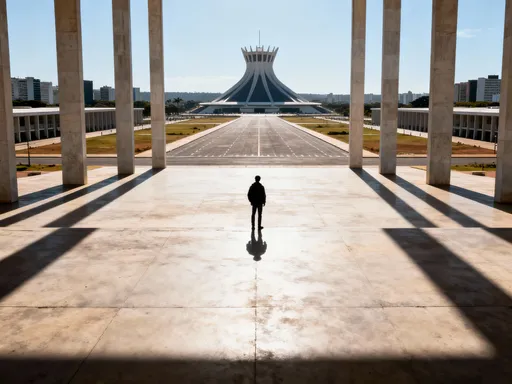
The Eixo Monumental, or Monumental Axis, is Brasília’s grand stage—a sweeping boulevard lined with some of the country’s most iconic government buildings. At its heart lies the Praça dos Três Poderes, where the executive, legislative, and judicial branches converge in dramatic architectural statements. The National Congress, with its twin towers flanked by dome and bowl-shaped chambers, projects strength and transparency. Nearby, the Palácio do Planalto, official workplace of the president, exudes restrained elegance. The Cathedral of Brasília, with its hyperboloid structure and stained-glass canopy, rises like a crown above the plateau, offering a spiritual counterpoint to the secular power surrounding it.
From a distance, these structures inspire awe. Their clean lines, sweeping curves, and monumental scale reflect the optimism of mid-century modernism. Photographs capture their grandeur perfectly, which is why they dominate travel brochures and social media feeds. But up close, the experience shifts. The vast open spaces between buildings—designed to emphasize dignity and separation—can feel isolating and inhospitable. Sun beats down on wide plazas with minimal shade, discouraging lingering. Sidewalks are narrow or absent in places, and crosswalks are spaced far apart, making pedestrian movement cumbersome. What reads as majesty in images becomes inconvenience in reality.
Accessibility remains a significant challenge. While the city was designed around automobile traffic, international visitors often underestimate just how unwalkable the Monumental Axis truly is. Distances between key sites can exceed one kilometer, and without reliable public signage or shaded pathways, walking becomes exhausting, especially during Brasília’s hot, dry season. Public transit options exist, including the Federal District Metro and bus corridors, but connections to major landmarks are not always intuitive. Tourists report confusion when trying to navigate from the Cathedral to the National Museum or from the TV Tower to the Itamaraty Palace. Even ride-sharing apps require precise addresses, which are not always well-known outside local circles.
Moreover, the symbolic nature of these spaces limits interactive engagement. Unlike historic capitals where government buildings evolved over centuries and invite curiosity, Brasília’s institutions are largely closed to casual visitors. Security is tight, and access to interiors often requires advance booking or official sponsorship. This creates a gap between the city’s visual impact and its experiential depth. You can admire the architecture, but you cannot feel part of its pulse. The result is a kind of architectural theater—beautiful to observe, but difficult to inhabit emotionally.
Cultural Zones That Fall Flat
Brasília was intended to be more than a political center; it was meant to be a cultural beacon. To this end, several districts were designated as hubs for the arts, education, and public discourse. The Cidade do Cinema (Film City) was established to promote national filmmaking, housing production studios, screening rooms, and training facilities. The Museu Nacional, part of the University of Brasília, was envisioned as a major repository of Brazilian history and natural heritage. Other spaces, such as the Centro Cultural Banco do Brasil and the Cláudio Santoro National Theater, were built to host performances, exhibitions, and community events.
In practice, however, many of these cultural zones struggle with visibility, programming, and attendance. The Cidade do Cinema, despite its ambitious goals, has faced inconsistent funding and limited public outreach. While it hosts occasional film festivals and workshops, its day-to-day presence remains low-key, and few tourists are aware of its offerings. Similarly, the Museu Nacional, though architecturally striking, has suffered from underutilized exhibition spaces and sporadic curation. After a devastating fire at Rio’s National Museum in 2018, attention turned to preserving Brazil’s cultural memory—but Brasília’s counterpart has not seen proportional investment or media coverage.
The disconnect between promise and reality extends to performance venues. The Cláudio Santoro National Theater, located in the Esplanada dos Ministérios, boasts excellent acoustics and modern amenities, yet its schedule is often sparse outside peak seasons. Locals report that tickets can be hard to obtain due to last-minute cancellations or bureaucratic delays. Even when events do take place, audience turnout is sometimes disappointing, partly because the city lacks a strong tradition of regular theatergoing or concert attendance compared to coastal cultural capitals.
Some revitalization efforts are underway. Pop-up art installations, independent film screenings, and university-led exhibitions have begun to breathe new life into these spaces. In recent years, the Centro Cultural Banco do Brasil has hosted traveling photography exhibits and interactive design workshops that draw modest but growing crowds. Grassroots collectives are also using social media to promote underground performances in repurposed buildings. These initiatives suggest that Brasília’s cultural potential is not lost—only dormant. The challenge lies in sustaining momentum and ensuring that programming aligns with both local interests and tourist expectations.
Residential Superblocks: Life Beyond the Tourist Trail
While much attention focuses on Brasília’s monumental core, the lifeblood of the city flows through its residential superquadras—repeating clusters of apartment buildings arranged in uniform blocks. Each superquadra was designed to accommodate approximately 10,000 residents, with shared green spaces, schools, clinics, and small commercial centers at ground level. Costa envisioned these zones as self-contained communities where families could live, work, and socialize without needing to travel far. The idea was to eliminate class-based segregation by offering identical housing units across the city, promoting a sense of civic equality.
For visitors, however, the uniformity of the superquadras can be disorienting. Without distinctive landmarks or architectural variation, one block easily blends into the next. Navigating by memory becomes difficult, and even GPS can falter when street names repeat across sectors. First-time travelers often report feeling lost, not because of complex routes, but because of visual monotony. This repetition, intended to promote order, can instead evoke a sense of detachment. Unlike the bustling streets of Salvador or the colonial charm of Ouro Preto, Brasília’s residential areas do not immediately invite exploration.
Yet, beneath the surface, authentic local life thrives. On weekends, neighborhood markets spring to life, offering regional foods, handmade crafts, and live music. The Feira da Torre, located between Superquadras 508 and 509, is one of the most vibrant, drawing both residents and curious tourists. Here, you’ll find pão de queijo, pastéis, and açaí served from colorful food stalls, alongside vendors selling tropical fruits, textiles, and herbal remedies. Street musicians play for tips, children run through fountains, and elderly couples sit under umbrellas enjoying conversation. It is in moments like these that Brasília reveals its warmth.
Public art is another quiet revolution transforming the superquadras. Murals depicting indigenous motifs, Afro-Brazilian heritage, and environmental themes now adorn building facades in sectors like Cruzeiro and Guará. Local artists, often supported by municipal grants or nonprofit organizations, use these large-scale works to reclaim visual space and express cultural identity. Walking tours led by community guides are beginning to emerge, offering insights into daily life and neighborhood histories. These experiences remind us that Brasília’s soul is not in its monuments alone, but in the quiet resilience of its people.
The Pitfall of Isolation: Why Brasília Doesn’t Feel Like a City
One of the most common critiques from travelers is that Brasília “doesn’t feel like a real city.” This sentiment stems from its fundamental design philosophy: a city built for cars, not people. Wide avenues, multi-lane highways, and vast parking lots dominate the landscape, while sidewalks are often narrow, uneven, or abruptly end. Crosswalks are infrequent, and traffic signals favor vehicles over pedestrians. As a result, walking long distances is neither convenient nor enjoyable, particularly under the strong Central Brazilian sun.
This car-centric model discourages spontaneous encounters—the kind that define urban life in cities like Paris, Tokyo, or Buenos Aires. There are few corner cafes where people linger over coffee, no narrow alleys filled with boutique shops, and limited street-level activity after dark. Even in Sector H, one of the few areas known for its nightlife, options remain concentrated and somewhat insular. Bars and restaurants cater primarily to locals with reservations or insider knowledge, leaving tourists feeling excluded. The lack of a continuous street grid means that discovering hidden gems by chance is nearly impossible.
Safety perceptions further reinforce isolation. While Brasília is generally safe for tourists in well-trafficked areas, certain zones—particularly on the city’s periphery—have higher crime rates. This reality, combined with poor lighting and sparse foot traffic in many sectors, makes evening walks unappealing. Families tend to stay within their superquadras, relying on private transportation for errands and leisure. The result is a fragmented urban experience, where social life unfolds in pockets rather than as a connected whole.
Visitor anecdotes illustrate this sense of disconnection. One traveler described spending an entire day visiting landmarks only to realize they had interacted with fewer than ten people outside ticket booths. Another recalled feeling “like a spectator in a museum of urban planning” rather than a participant in city life. These reflections point to a deeper issue: Brasília was designed to represent ideals, not to accommodate the messiness of human behavior. When tourists expect vibrancy and find silence, the mismatch can be jarring.
Navigating the Zones: A Smarter Way to Experience Brasília
Despite its challenges, Brasília can be deeply rewarding—with the right approach. The key lies in adjusting expectations and adopting strategies that align with the city’s unique structure. Rather than trying to walk between distant sectors, consider renting a bicycle or using the city’s expanding bike lane network. Cycling allows you to cover ground efficiently while enjoying open-air views of the architecture. For longer distances, the Federal District Metro offers a reliable option, connecting key points such as the Central Station, Convention Center, and Águas Claras. Combining metro rides with short taxi trips can optimize time and comfort.
Timing also matters. Brasília’s climate features intense sunlight and high temperatures, especially from August to October. To avoid heat exhaustion, plan outdoor visits for early morning or late afternoon. Midday is better suited for indoor experiences—museums, cultural centers, or air-conditioned cafés. Guided tours, particularly those led by local historians or architects, provide invaluable context. They explain the symbolism behind Niemeyer’s curves, the political history embedded in the Plano Piloto, and the evolving identity of Brasília’s residents. These narratives transform sterile plazas into meaningful spaces.
To experience the city’s cultural heartbeat, blend official landmarks with grassroots activities. After touring the Cathedral, head to the Feira da Torre for lunch and live music. Visit the Museu Nacional, then explore nearby murals in Cruzeiro with a self-guided walking map. Attend a performance at the Cláudio Santoro Theater, and afterward, join locals at a neighborhood churrascaria. These combinations create a richer, more balanced itinerary. Apps like Guia Turístico do DF offer updated event listings and visitor tips, helping you stay informed about pop-ups and seasonal festivals.
Finally, embrace flexibility. Brasília does not reward rushed itineraries. Allow time to sit in a quiet plaza, observe daily rhythms, and engage with residents. Learn a few Portuguese phrases—locals appreciate the effort, even if they respond in English. Ask shopkeepers about their favorite spots; you might discover a hidden bakery or a community garden tucked between superquadras. By slowing down and seeking connection, you move beyond the surface and begin to understand Brasília on its own terms.
Reimagining the Capital: Where Brasília Is Heading
Brasília is not static. Beneath its polished façade, a quiet transformation is unfolding. Urban renewal projects are rethinking public spaces, introducing green corridors, pedestrian plazas, and community gardens. The city government has launched initiatives to revitalize underused cultural centers, partnering with artists and educators to develop engaging programming. In 2023, a temporary open-air exhibition transformed a vacant lot near the TV Tower into an interactive art park, drawing thousands of visitors and sparking conversations about adaptive reuse.
Youth-driven movements are also reshaping the city’s identity. Skateboard collectives, hip-hop crews, and environmental activists are reclaiming public spaces once deemed too formal or inaccessible. Graffiti tours, rooftop cinema nights, and pop-up markets reflect a growing desire for creativity and inclusion. Social media plays a crucial role, enabling young Cariocas—not to be confused with residents of Rio, but a colloquial term for people from the Federal District—to share their visions and mobilize support. These efforts challenge the notion that Brasília must remain frozen in its original blueprint.
At the same time, policymakers are reconsidering zoning rigidity. Pilot programs now encourage mixed-use development in select sectors, allowing small businesses to operate within residential superquadras. This shift could breathe new life into ground-floor spaces currently underutilized. Improved lighting, expanded bike lanes, and better signage are gradually making the city more walkable. While change is slow, the direction is clear: Brasília is learning to balance its modernist legacy with human-centered design.
In the end, Brasília is not broken—it is unfinished. Its theme-based planning was a bold experiment, one that succeeded in creating a powerful symbol but fell short in fostering organic community life. Yet, its flaws do not diminish its importance. Instead, they invite us to look deeper, to question what a capital city should be, and to imagine how urban spaces can evolve to serve people, not just plans. For the thoughtful traveler, Brasília offers more than monuments. It offers a mirror—one that reflects both the promise and the pitfalls of designing a future from scratch. With awareness, respect, and intention, it is possible to move beyond the traps and discover a city that, slowly but surely, is learning to feel like home.